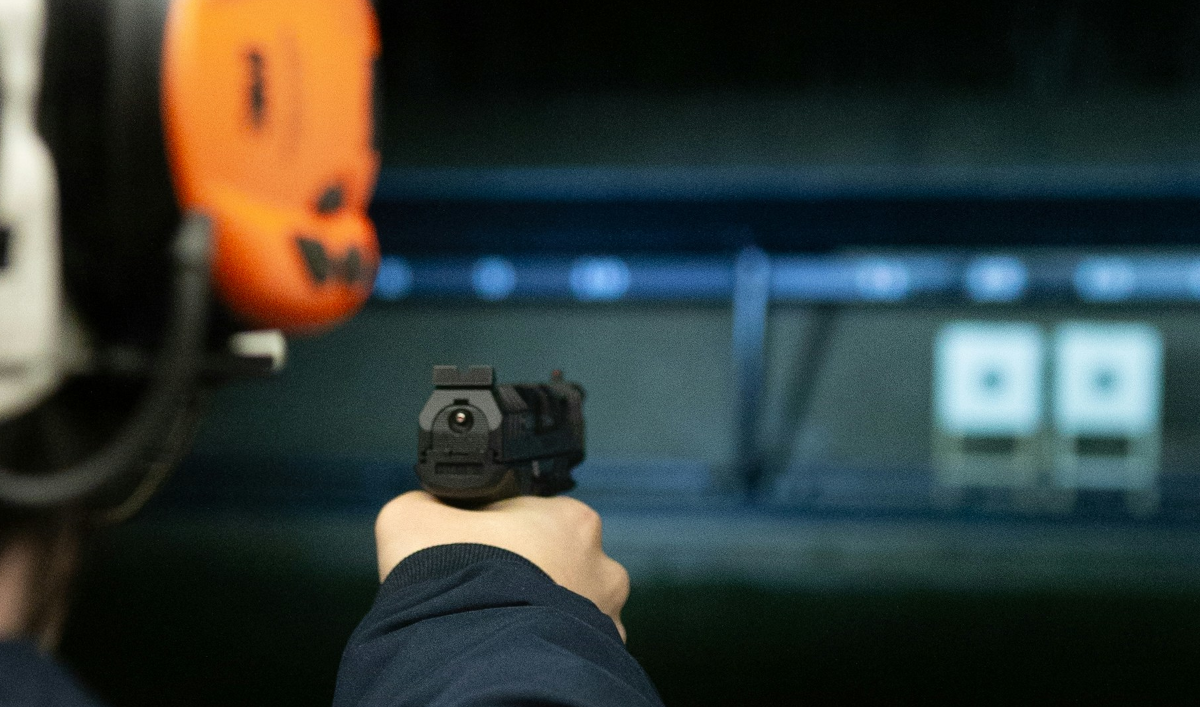
Shooting is a Hand-Eye Coordination Skill
While most people might not realise it, shooting a firearm accurately probably needs a higher degree of hand-eye coordination than they might think.
In principle, one has to simply see the sights precisely aligned with the target before one can squeeze the trigger, if one one wants to accurately hit the target. Which is obviously a form of hand-eye coordination, as many people of course would agree.
But what I certainly did not realise myself, was there is perhaps actually a lot more going on.
In fact what I have come to realise, it might be a bit like learning to hit a cricket ball or tennis ball with a bat. Which may sound strange, but for example, experienced cricket players will tell you that they cannot actually see a fast ball when it’s bowled, because it’s moving too fast. But nevertheless they learn how to reliably hit the ball, using the visual indicators given by the way the bowler runs up and releases the ball. While this analogy stretches what I am trying to suggest quite a lot, the similarity between cricket batting and shooting is that even though the batter cannot actually see the ball all the way onto the bat, they use their vision together with their well developed hand-eye coordination, built through extensive experience and training, in order hit the ball.
I believe the same sort of thing happens when we shoot. Obviously it’s not exactly the same thing as what is going on during a cricket game, but I am suggesting it’s similar, and at least more complex than one initially would assume.
For example, this probably is very relevant to clay pigeon shooting. Where the shooter needs to learn to shoot at the spot in space where their brain predicts the flying clay will be, based on its trajectory, speed etc, typically without actually using the sights in the “normal” way (which is probably why those shotguns have fairly simple sights?). So while using vision is crucial, to track the trajectory and assess the speed of the flying clay, so is coordination of body movements to bring the gun up, point in the right direction and know when to fire. It’s quite complex, and probably not as simple as focusing on your front sight to decide when to shoot?
But I believe some of this is going on, even when the target is relatively static, or completely static.
For example, many practical sports shooting competitors, while taking part in those competitions (such as IPSC), which require moving quickly between a collection of targets, laid out in some sort of course, shooting as quickly as possible, will sometimes tell you that they don’t remember even seeing their sights during a stage, even when they did quite well.
Now I’m not for a moment suggesting one should stop using your sights to try emulate top competitive combat sport shooters. But I am pointing out that what is going on is perhaps not quite exactly the same thing, as what we have been taught.
Because how can someone shoot well without even seeing their sights? This tells me the hand-eye coordination developed and used by that shooter is far more complex, and perhaps similar, maybe, to what is happening in cricket? Where the batter eventually works out how to hit an incoming fast ball, even though he cannot even see the ball?
I can actually attest to this myself, to a very limited extent, having taken part in some of those competitions. I have also found myself at times shooting in the same more instinctive way, and also cannot remember actually seeing my sights in some stages – and in some of those stages I did quite well (at least for my level of capability). Although I would also admit that in some of those cases, I also shot quite badly. And in general, I personally would definitely say it is always better to see your sights properly on target each time you pulled the trigger.
My Actual Experience Seems to Contradict Conventional Wisdom
Now in general, I have learned a huge amount from following the accumulated conventional wisdom and knowledge of how to shoot well, which is freely available on the internet, from very accomplished people, some of whom are world champions and world record holders in their specific shooting disciplines, and I would not pretend to know better – at all!
And again, in general, when I have taken that advice and wisdom on board, it has usually made a positive difference to my overall ability. Sometimes significantly so!
However for one such element of conventional wisdom, my experience just does not correlate! Which I am quite prepared to admit may just be my own fault, or ignorance, or due to my own physiology. In particular, as I have gotten older, I am no longer able to focus my eyes properly on things close to me. Which may explain this whole thing?
I am referring to the advice of focusing on your front sight when aiming (obviously when using traditional “iron sights”), especially on a hand gun.
I know I am supposed to switch my focal plane, to get my front sight into nice and sharp focus, with the target blurred in the background. But even though I have tried hard to do this, to the extent I am able, it just doesn’t seem to help, and actually seems unnecessary for me.
I find I can shoot better if I just focus my vision on the target, precisely where I want to hit, while both the front and rear sights remain blurred. I can still quite easily tell if the sights are properly aligned, even though they are blurred, and use that to decide when to fire the shot to hit the target where I want to.
Perhaps this is because I simply cannot get those sights into focus, without glasses anyway? So I have grown used to seeing them blurred? (And just for the record, I have found that I cannot shoot properly wearing prescriptive glasses, which would allow me to get the front sight into focus. I have tried, it makes me feel sea sick! And in any event, in my opinion, it’s not really practical, from a self defence point of view, among others, to limit my ability to shoot properly to only when I have the correct pair of glasses available – so I would much rather just shoot without glasses.)
And in any event, at least to me, it now seems that the whole requirement to change focus from the target to the front sight seems counter productive, and not natural?
In a Self Defence Situation, Your Focus Will Naturally be on the Target
If you are ever unfortunate enough to have to use your firearm to defend yourself against an attacker, I would suggest that your focus is definitely going to be held on that target! It would be your natural instinctive response. So why train yourself to do something different, if you don’t have to?
I would even go further.
In a true self defence situation, focusing on the target, and what is happening all around in the vicinity, keeping both eyes open, will be better for your situational awareness, than reducing your focus down to less than arms length, as you focus on your front sight, with everything else around you blurred?
I very much doubt anyone would actually do this in a life-or-death fire fight? Although I am lucky enough to not know for certain, having no hard experience in that regard.
But certainly for me, I am quite capable of hitting targets using my current methods, and find that the advice to focus on the front sight not that useful. But that may just be down to my loss of ability to focus my eyes on things close to me?
The point remains though, that it is possible to hit the target accurately and reliably without seeing the front sight sharply in focus, certainly at normal handgun ranges.
And I as tried to suggest at the beginning of this article, I am now thinking, what is going on inside our brains in terms of the muscle memory and hand-eye coordination, developed during training, is a bit more (or perhaps a lot more) complex than current wisdom implies? Our brains are probably quite capable of working out when to shoot, based on incoming visual stimuli, accumulated during hours of training, but which is perhaps slightly different to what is currently being taught?
Balancing the Jelly Bean
A silly little training method I have adopted, which I noticed has made a noticeable improvement, is a mind game I play with myself while dry-fire practice.
I printed out some standard SAPSA (formerly MDPS) targets, on normal A4 size paper, to use as dry-fire targets. The SAPSA scoring system is similar to the IPSC system, but slightly different. What IPSC calls the “A zone” is denoted the 0 (zero) zone in SAPSA. If your bullets hit that inner preferential target zone, zero seconds are added to your stage time. The next outer zone is denoted -1. So you lose a second for every bullet hitting that zone, instead of the more desirable inner zero zone, which is added to your stage time. The last outer zone is denoted -3, where you lose three seconds per bullet that hits that zone, instead of the inner zones.
Anyway, the relevant point for this story, is my printed targets have a reasonably small “0” printed in the centre zone of the targets.
And I have naturally come to use that as my aiming point when dry fire training.
But I also started to pretend that when I am dry-firing, that the “0” is in fact a jelly bean hanging in space, but which while I am aiming at it, is unstable and can actually fall to the ground. So my job, while dry fire training, is to balance that “jelly bean” on my front sight and not allow it to fall off, as I pull the trigger.
The more that I do this, the better my real life shooting has become.
The side effect, is that I am 100% focused on the “jelly bean”, as I practice dry firing, NOT the front sight. I can see the front sight, in order to determine whether it twitches or jerks or not, as I pull the trigger, but it is blurred. But that makes no real difference to me.
And I have found that when going to the range, to fire real bullets, even though there is no “jelly bean” to see on those targets, I find I don’t need to focus on my front sight, while I can easily retain the actual target in focus as I shoot. My shooting (mostly, when I get it right, and if I practice enough) is as accurate as I would require out to 20 meters or so, where I can achieve reasonably consistent head shots at that range, on the normal SAPSA target.
Now that may be nothing special to a lot of more accomplished shooters, I know. But for me that represents a systematic improvement over what I was able to do, before I started to adopt this little game of pretence during dry fire training.
And I am focusing on the target throughout, not the front sight, although I definitely use the blurred sights to aim properly. And I find this quite intuitive and instinctive.
It also helps in transitions between different targets. Where one just switches your target focus from one target to the other, and then moves your blurred sights from one aiming point to the other, without having to get your eyes to adjust their focal plane back and forth, between the targets and the front sight. You just look at the new target, decide on what point on that target you want to aim at, and then move the blurred sights to align with that point.
To me this feels far more intuitive and natural?
I tried to get a photo of what I see when I train in this way, by strapping my pistol to a tripod and using various camera settings to try emulate my sight picture, which turned out very difficult!
This was the best I could do.
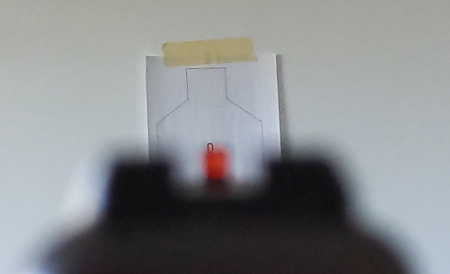
In the photo above, you can sort of see what I am trying to describe. Although not quite. The camera lens shows a different view to what my eyes see, due to different focal lengths and apertures. For example, when seen from my eyes during dry fire training, with the gun held in the normal shooting position in front of me, and with that target about 5 meters away, the gun and the sights are much smaller, and no where near as blurred, and the target is much larger.
Also in this photo, one can see that the front sight is not properly aligned with the rear, being slightly too high, and not completely centered. Nor is it properly aligned with the “jelly bean”. All of which does illustrate that even though the sights are very blurred, it’s still quite easy to tell if they are properly aligned. But in any case, that was the best photo, out of many attempts, to portray the sight picture I am describing above, with the “jelly bean” balanced on the front sight. I think it conveys what I am trying to say sufficiently?
Now I will accept that at much longer ranges, this approach might start becoming less than ideal. But then the normal quite chunky iron sights on most pistols were never designed for long range precision shooting in any case?
My argument is constrained to normal self defence type distances, because that is what I am ultimately training for.
My suggestion is that one can still achieve adequate accuracy, without needing to get the front sight in focus, and that there may be some other advantages when adopting that approach, especially as one gets older and cannot in any case get the front sight into sharp focus anymore at all without glasses?
